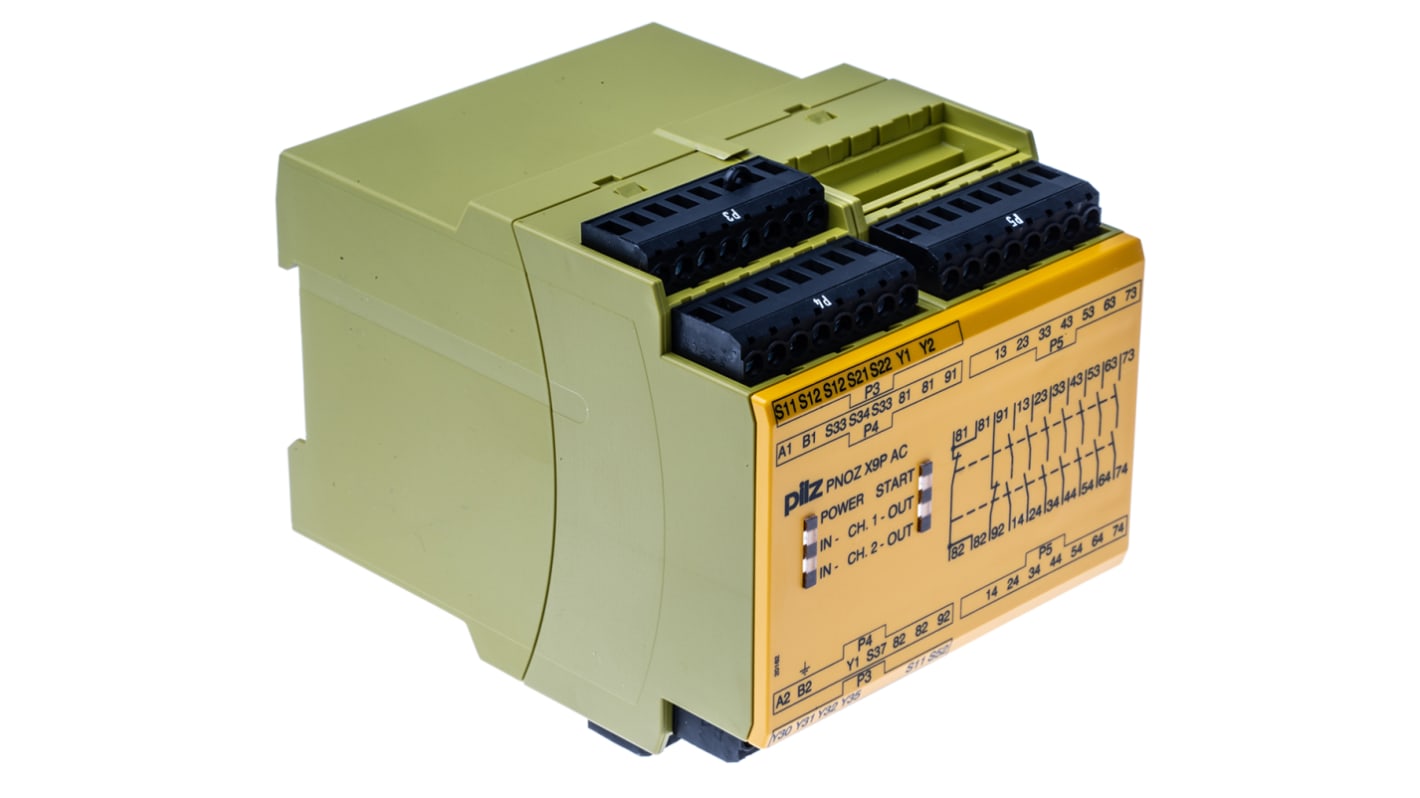
Pilz Single/Dual-Channel Safety Switch/Interlock Safety Relay, 24 → 240V ac/dc, 7 Safety Contacts
- RS-stocknr.:
- 489-6388
- Fabrikantnummer:
- 777606
- Fabrikant:
- Pilz

4 op voorraad - levertijd is 1 werkdag(en) (EU-voorraad)
7 op voorraad - levertijd is 3 à 5 werkdagen (UK-voorraad)
Prijs Per stuk
€ 566,91
(excl. BTW)
€ 685,96
(incl. BTW)
Aantal stuks | Per stuk |
|---|---|
| 1 + | € 566,91 |
- RS-stocknr.:
- 489-6388
- Fabrikantnummer:
- 777606
- Fabrikant:
- Pilz
- Land van herkomst:
- FR
PNOZ X9P Safety Relay by PILZ
The PNOZ X9P range of safety relays from PILZ, offering you a wide range of safety functions. The PNOZ X9P offers you different modes of operation such as single or dual channel switches. Suitable for several different applications which are listed below.
Features and Benefits:
• LED displaying supply voltage, switch status, reset circuit & input circuit monitoring
• Automatic reset
• Manual reset
• 2 Semiconductor outputs
• Automatic reset
• Manual reset
• 2 Semiconductor outputs
Safety features
• Built in self-monitoring
• Safety functions remain effective in the event of components failure
• Correct opening and closing is tested automatically at the end of each on / off cycle
• The transformer uses a DC electronic fuse which prevents short circuiting
• Safety functions remain effective in the event of components failure
• Correct opening and closing is tested automatically at the end of each on / off cycle
• The transformer uses a DC electronic fuse which prevents short circuiting
Applications
• E STOP pushbutton
• Safety gate limit switches
• Reset buttons
• Light barriers
• Light beam devices
Technical safety parameters
• EN 60947-5-1
• EN 60204-1
• VDE 0113-1
• EN 60204-1
• VDE 0113-1
How do Safety Relays work and what are they used for?
Safety Relays work by helping reduce unnecessary risk and hazard within your circuit. A typical circuit configuration may look like a production line where highly automated machinery works quickly, i.e. a production or packing line in a warehouse or factory. This line forms part of your 'circuit' and along that circuit you will have safety devices in place like emergency push buttons, safety curtains or pressure sensitive mats. To ensure complete safety in these environments, a safety relay can be added to your circuit to allow you full control and monitoring of your working environment. A safety relay will run regular checks down your circuit by sending pulses back and forth to confirm whether any (for example) wiring was implemented incorrectly or any welding has occurred along the circuit. Once the relay has detected this, it would then shut down the area by cutting off the power until the fault can be determined and fixed. Most recent safety relays feature intuitive LED displays that will alert users to any faults, this is of course useful to prevent harm to users and also proactively engage in maintenance before any machinery is damaged beyond repair, so certain cost savings can be associated when using a safety relay.
Some safety relays have specific functions and only work with certain devices like E-STOPs, some work better with other devices like safety curtains. More than one safety relay can be used to give you total monitoring of your circuit, ensuring you and your employees safety.
Some safety relays have specific functions and only work with certain devices like E-STOPs, some work better with other devices like safety curtains. More than one safety relay can be used to give you total monitoring of your circuit, ensuring you and your employees safety.
What are the differences between a traditional 'relay' and a 'safety relay'?
A traditional relay will open and close your circuit and the switch devices down that line, however it will not monitor it in the same way a safety relay will and cannot automatically shut down specified areas to prevent harm to the machinery or workers. Safety relays are not prone to the same potential risks that traditional relays are and can be relied upon to monitor short circuit faults, ground faults or wire breakage. Offering a greater protection over their counterpart relays, they are specifically designed with your safety in mind.
How do you operate a Safety Relay?
You must first align and wire the safety relay into your line and follow the setup instructions provided (will vary per manufacturer). Follow the on-screen instructions of the LED parallel to your instructions to perform integration into your circuit line. Depending on what parameters you set will determine the function of the safety relay (i.e. you tell it to cut off certain areas after certain criteria have been met, or you opt for a circuit wide halt of the line).
Standards
EN954-1, IEC / EN60204-1
Approvals
BG, UL listed for Canada and US
Kenmerk | Waarde |
|---|---|
| Supply Voltage | 24 → 240V ac/dc |
| Number of Channels | 1, 2 |
| Safety Contacts | 7 |
| Function | Safety Switch/Interlock |
| Auxiliary Contacts | 2 |
| Range | PNOZ X |
| Safety Category ISO 13849-1 | 3 |
| PL ISO 13849-1 | e |
| SIL IEC 61508 | 3 |
| Terminal Type | Screw |
| Series | PNOZ X9P |
| Depth | 121mm |
| Width | 90mm |
| Length | 94mm |
| Performance Level | e |