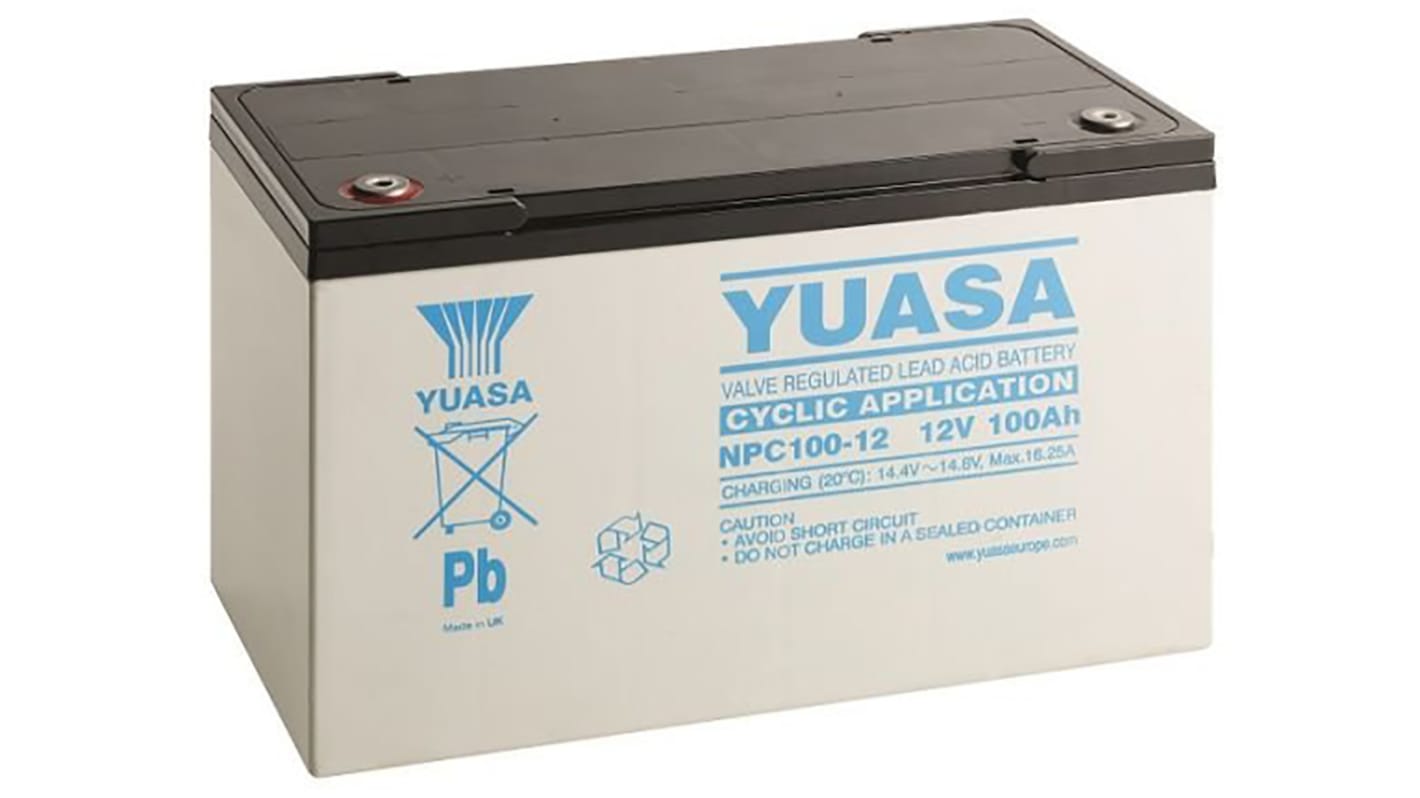
Yuasa 12 V Sealed Lead Acid Battery, 100 Ah, 168 mm x 225 mm
- RS-stocknr.:
- 906-4233
- Fabrikantnummer:
- NPC100-12
- Fabrikant:
- Yuasa

Subtotaal (1 eenheid)*
€ 592,06
(excl. BTW)
€ 716,39
(incl. BTW)
GRATIS bezorging voor bestellingen van meer dan € 75,00
Op voorraad
- 8 stuk(s) klaar voor verzending vanaf een andere locatie
Heeft u meer nodig? Klik op 'Controleer leverdata' voor extra voorraad en levertijden.
Aantal stuks | Per stuk |
|---|---|
| 1 + | € 592,06 |
*prijsindicatie
- RS-stocknr.:
- 906-4233
- Fabrikantnummer:
- NPC100-12
- Fabrikant:
- Yuasa
Specificaties
Datasheets
Wetgeving en compliance
Productomschrijving
Zoek vergelijkbare producten door een of meer kenmerken te selecteren.
Alles selecteren | Attribuut | Waarde |
|---|---|---|
| Merk | Yuasa | |
| Product Type | Sealed Lead Acid Battery | |
| Battery Capacity | 100Ah | |
| Nominal Voltage | 12V | |
| Construction | AGM | |
| Flame Resistant | No | |
| Designed for Cyclic Application | Yes | |
| Designed for High Rate Application | No | |
| Eurobat Classification | 3 to 5 Years | |
| Minimum Operating Temperature | -20°C | |
| Maximum Operating Temperature | 60°C | |
| Weight | 38.8kg | |
| Standards/Approvals | No | |
| Series | NPC100-12I | |
| Height | 225mm | |
| Width | 168 mm | |
| Alles selecteren | ||
|---|---|---|
Merk Yuasa | ||
Product Type Sealed Lead Acid Battery | ||
Battery Capacity 100Ah | ||
Nominal Voltage 12V | ||
Construction AGM | ||
Flame Resistant No | ||
Designed for Cyclic Application Yes | ||
Designed for High Rate Application No | ||
Eurobat Classification 3 to 5 Years | ||
Minimum Operating Temperature -20°C | ||
Maximum Operating Temperature 60°C | ||
Weight 38.8kg | ||
Standards/Approvals No | ||
Series NPC100-12I | ||
Height 225mm | ||
Width 168 mm | ||
Vrijgesteld
- Land van herkomst:
- GB
YUASA NPC Range
Introducing the NPC series, sealed lead-acid batteries from Yuasa. This rechargeable 12 voltage batteries are low maintenance and valve regulated combined with heavy-duty plates and unique separator systems to make NPC service twice as long compared to conventional VRLA batteries.
Why would you buy an NPC series battery?
Double cycle life
NPC operates 500 charges/discharge cycles or twice as many cycles as conventional cycle use batteries at 75%D.O.D. (depth of discharge).
Valve-regulated and maintenance-free
Battery electrolyte retained solidly in the separator and the innovative gas recombinant system allows minimum gas emittance freeing the user from maintenance.
Durability for deep discharge use
Yuasa’s state-of-the-art plate barrier prevention and the unique separator systems help endure deep discharge use thus considerably prolonging battery’s service life
Minimal self-discharge
Cyclic use batteries tend to be left discharged after usage causing plate corrosion leading to shortened life. The self-discharge rate of NPC is as small as only 0.1% a day at 20°C and thus extends the storage period allowed.
Features and Benefits
• Voltage: 12 V
• Lead-Acid battery
• Rechargeable
• Sealed
• Heavy-duty lead Calcium Grids for superior cyclic life
• Double cycle life
• Absorbed Glass Mat construction with no free acid (AGM)
• Gas recombination
• Excellent recovery from deep discharge
• Operation in any orientation (excluding continuous inverted use)
• Eurobat Classification: 3 to 5 years
• Compatible charger available separately
Options
• NPC24-12: 24Ah, 125 x 166 x 175 mm; RS stock no: 198-8125
• NPC38-12: 38 Ah, 197 x 165 x 170 mm; RS stock no: 257-8369
• NPC100-12: 100 Ah, 350 x 168 x 225 mm; RS stock no: 906-4233
Terminal Type
• M5 (Female);• M8 (Female)
Operating Temperature Range
• Storage (in fully charged condition) -20°C to +60°C
• Charge -15°C to +50°C
• Discharge -20°C to +60°C
Typical Applications
• Wheelchairs
• Golf trolley
• Communications
• Pumps
• Measuring instruments
• AGV (Automatic guided vehicle)
• Magnetic lifts
• Mobility Scooters
• Industrial applications
• Emergency Lighting
• Professional Electric Tools
GEL Vs Lead Acid (AGM)
Absorbed Glass Mat
These batteries contain only enough liquid to keep the specially designed glass mat wet. The glass mat is made to wick the battery electrolytes between the battery plates. If the battery is broken no free liquid leaks out.
AGM batteries are preferred when a larger number of amps are required. The life expectancy remains excellent in most cases if they are not discharged more than 60% between recharges and/or recharged fully every 3-6 months.
Gel Cell Batteries
These batteries contain silica type gel, which is a thick paste-like material. It allows the electrons to flow between plates but will not leak in a gel battery if the case is broken.
Gel Cell Batteries don't offer the same power capacity as per the same physical size as AGM batteries. Gel cell batteries excel in slow discharge rates and slightly higher operating temperatures and with excellent deep cycle capability. Recharging these batteries must be done correctly or it will suffer premature failure.
FAQ's
Is a Is lead Acid Rechargeable Battery Harmful?
Lead-Acid batteries contain chemicals that have the potential to be harmful to both your health and the environment. They contain lead which is a highly toxic metal and sulfuric acid which is a corrosive electrolyte solution. Proper handling procedures must be followed always.
What state of charge will the battery be in when delivered?
The NPC Range will have 90% to 95% of charge approximately, we do recommend charging prior to use.
How to dispose of Lead Acid Batteries?
Lead-acid batteries do contain hazardous chemicals, so recycling is the only way to dispose of them.
Recycle responsibly. A wide range of schemes are available.
Note
These batteries should be charged with a constant voltage charger at 2.3V per cell standby and 2.5V per cell with a current limit of 0.25 x capacity (Ah) for cyclic applications (max 20 hour charging).
Warning
Do not charge in a sealed enclosure
Gerelateerde Links
- Yuasa 6V M8 Sealed Lead Acid Battery, 100Ah
- Yuasa 12V Insert BM10 Sealed Lead Acid Battery, 100Ah
- RS PRO 12V T11 Sealed Lead Acid Battery, 100Ah
- Fiamm 12V Sealed Lead Acid Battery, 100Ah
- Enersys 12V SAE Sealed Lead Acid Battery, 100Ah
- Yuasa 6V M8 Sealed Lead Acid Battery, 160Ah
- ENIX Energies 12V Standard Sealed Lead Acid Battery, 100Ah
- Yuasa 12V Insert M8 Sealed Lead Acid Battery, 111Ah